ADVERTISEMENT
You pull a slice of roast beef from the deli tray.
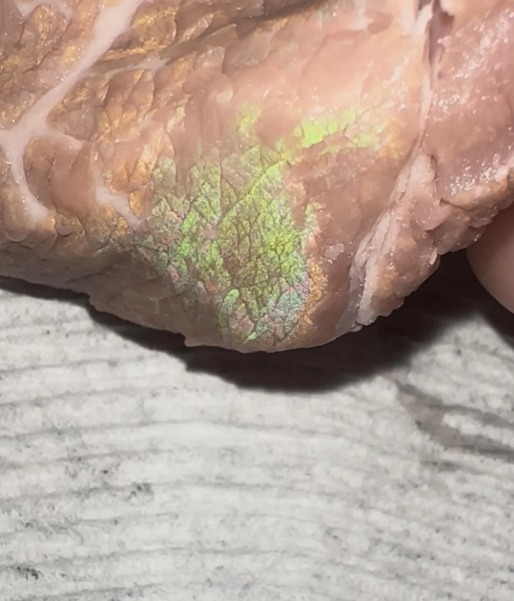
Sunlight hits it just right… and suddenly, your meat looks like it’s been dipped in oil or lit up with a disco ball.
Shades of emerald green, electric blue, and magenta shimmer across the surface.
Wait — is it bad?
Is it contaminated?
Did someone dye my lunch?
Relax.
That rainbow sheen on your meat isn’t a sign of spoilage or food fraud.
It’s called “diffraction” — and it’s nature’s way of turning muscle fibers into a prism. 💡
Let’s break down why this happens, when you should worry, and why your lunch isn’t secretly a unicorn. 🦄
🔬 What Causes the Rainbow Effect on Meat?
The colorful glow you see is structural color, not pigment — much like the iridescence on a butterfly wing or a soap bubble.
Here’s how it works:
1️⃣ Tightly Packed Muscle Fibers
1️⃣ Tightly Packed Muscle Fibers
Meat is made of long, parallel protein strands (like microscopic ropes).
When meat is sliced — especially deli-thin — these fibers are cut cleanly, creating an almost perfectly smooth, grooved surface.
2️⃣ Light Hits the Grooves
When light strikes this finely sliced surface:
It bounces off the tiny ridges between fibers
The waves bend and scatter — a phenomenon called diffraction
Different wavelengths (colors) bend at different angles
👉 Result? A rainbow-like sheen that shifts as you move the meat or change your viewing angle.
3️⃣ Wetness Makes It Worse (or Better?)
A moist or slightly greasy surface enhances the effect — acting like a lens that amplifies the colors.
💡 Fun Fact: This is most common in cured meats like roast beef, ham, turkey, and pastrami — because they’re often sliced very thin and have a smooth texture.
✅ Is Rainbow Meat Safe to Eat?
Yes — in nearly all cases.
If the meat:
Smells normal (no sour or rotten odor)
Feels tacky but not slimy
Has no mold or off-colors (like gray-green or black spots)
👉 Then that rainbow shimmer is harmless physics, not a health hazard.
🧠 Think of it like the colors on a CD — cool, unexpected, but totally safe.
❌ When Should You Be Concerned?
Rainbow hues are usually fine — but don’t ignore these red flags:
Slimy texture
Bacterial growth — time to toss it
Sour, ammonia, or sulfur smell
Spoilage — trust your nose
Gray, green, or fuzzy patches
Mold or advanced decay
Sticky or tacky feel
Microbial activity beginning
⚠️ If any of these are present — even with rainbows — throw the meat out.
But if it looks like a science experiment and smells like roast beef?
Go ahead. Make that sandwich. 🥪
🍖 Why Some Meats Show It More Than Others
Deli Roast Beef
Thinly sliced, moist, high in myoglobin (pigment that reflects light)
Ham & Turkey Breast
Smooth, cured surface enhances diffraction
Pastrami & Corned Beef
Spices and brine can amplify the sheen
Raw Fish (like salmon)
Also shows iridescence for the same reason
🚫 Rarely seen in: Ground meat, chicken breast (unless wet), or heavily marinated cuts — because the surface is too rough or uneven.
❤️ Final Thought: Nature Is Full of Hidden Wonders
You don’t need a lab coat to witness magic.
Sometimes, it’s right on your sandwich plate — a flash of green on a slice of turkey, a purple glimmer on roast beef.
That rainbow effect isn’t broken meat.
It’s muscle meets physics — proof that even something as simple as a protein-packed slice can dazzle under the right light.
So next time you see it…
Don’t panic.
Appreciate it.
Because great things — even delicious ones — can be both beautiful and edible. 💛
ADVERTISEMENT
