ADVERTISEMENT
Instead, he said:
“Don’t call my daughter again.”
Diane’s face collapsed.
The deputies took her through the side door.
And just like that, the woman who had controlled every room she entered vanished behind one she could not command.
Two years passed.
Emma turned seven.
She became loud again.
Not exactly the same loud as before.
Trauma does not return what it borrows in the same shape.
But she laughed.
She ran.
She argued about bedtime.
She hated green beans with theatrical passion.
She loved science.
Especially the human body.
She told people she wanted to become “a doctor who checks if grandmas are lying.”
Her therapist said that was normal.
I chose to believe her.
Andrés earned more time with her slowly.
Supervised visits became monitored exchanges.
Monitored exchanges became daytime visits.
Daytime visits became one overnight every other weekend when Emma asked for it.
He never pushed.
That mattered.
He labeled all medicine in his house.
He sent photos before giving even children’s Tylenol.
He kept Diane’s name out of conversations unless Emma brought it up.
He went to therapy for two years.
He joined a support group for adults raised by controlling parents.
He learned words like enmeshment, coercion, learned helplessness, emotional abuse.
Words I wish we had known sooner.
We did not get back together.
People expected that.
Some even wanted it.
They liked the idea of redemption tied neatly with a bow.
But real life is not obligated to become a comforting story.
I cared for Andrés.
I watched him become a better father.
I accepted his apology.
But I did not move back into a marriage where my child’s safety had been the price of his awakening.
Forgiveness did not require returning to the scene of the wound.
We became co-parents.
Careful.
Respectful.
Sometimes sad.
Always Emma first.
On her eighth birthday, we held a party at the park.
Clara brought cupcakes.
My father brought the old bunny bed, repaired for the third time.
Andrés brought a telescope.
Emma screamed with joy.
Not a small scream.
Not polite.
A full, wild, living scream.
Every adult froze for half a second.
Then we all laughed.
Because once, someone had tried to turn that sound off.
And failed.
That evening, after everyone left, Emma and I sat on the grass while the sun went down.
She leaned against me, sticky with frosting.
“Mommy?”
“Yes?”
“Do you remember when I told you about the pills?”
My chest tightened.
“Yes.”
“Were you mad at me?”
I turned her face toward mine.
“Never.”
“Not even a tiny bit?”
“Not even a tiny bit.”
She looked at the sunset.
“I thought you would get sick because of me.”
“I know.”
“Grandma lied.”
“Yes.”
Emma was quiet for a while.
Then she said:
“My body knew before my mouth did.”
I stared at her.
“What do you mean?”
“My tummy felt scared when she came near me. But she smiled, so I thought my tummy was wrong.”
I pulled her closer.
“Your tummy was trying to protect you.”
“Should I listen next time?”
“Yes,” I said, my voice thick. “Always.”
She nodded.
Then she stood and ran toward the playground, shouting for Andrés to push her on the swings.
I watched her go.
Her curls bounced.
Her sneakers flashed.
Her laugh rose into the evening air.
And I realized something.
For so long, I had thought the story was about the day I discovered the pills.
The orange bottle.
The hospital.
The police.
The trial.
But that was not the whole story.
The real story was that my daughter had found one safe sentence inside herself.
Mommy, can I stop?
That question saved her.
Not because I was perfect.
I wasn’t.
Not because I saw everything.
I didn’t.
It saved her because, beneath fear and threats and drugged silence, some part of Emma still believed I would hear her.
And I did.
Late.
Terrified.
Imperfectly.
But I heard her.
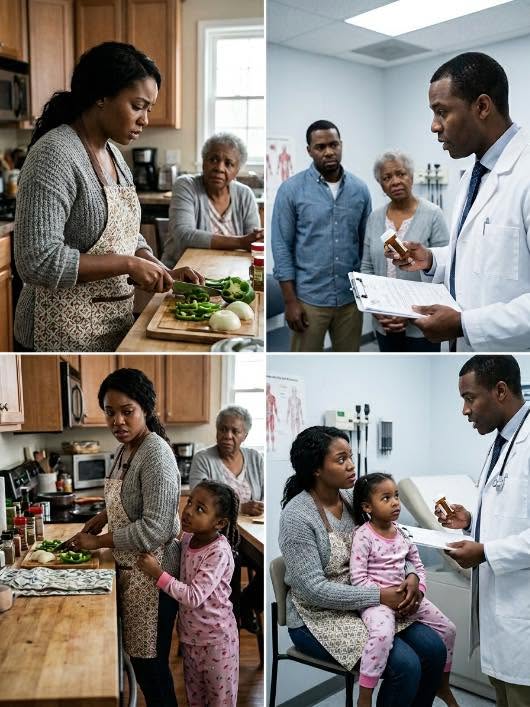
That night, after the party, I stood in the kitchen of our townhouse chopping vegetables.
Zucchini.
For a long time, I had avoided it.
The smell brought back the knife hitting the cutting board.
The silence.
The dread.
But healing sometimes asks you to return to ordinary things and make them ordinary again.
Emma climbed onto a stool beside me.
“Can I help?”
I handed her a plastic knife and a cucumber.
She sliced with great seriousness.
Andrés had taken her telescope to the backyard to set it up.
Clara was washing dishes.
My father was asleep in the recliner.
The house was noisy.
Messy.
Alive.
Emma paused suddenly.
“Mommy?”
My hand tightened around the knife.
Old fear rose fast.
“Yes, baby?”
She held up a cucumber slice.
“Can I stop eating these? They taste like wet grass.”
For one heartbeat, I stared at her.
Then I laughed.
I laughed so hard Clara turned off the sink and came running.
Emma laughed too.
“What?”
I pulled her into my arms.
“Nothing. You can stop eating the wet grass.”
She giggled against me.
And in that bright, ridiculous kitchen, with vegetables on the counter and my daughter’s arms around my waist, I felt the old terror loosen another finger from my throat.
Diane had wanted quiet.
But my daughter was laughing.
Diane had wanted obedience.
But my daughter was refusing cucumber.
Diane had wanted to make me disappear.
But I was there.
Holding the child she had tried to steal.
Listening.
Always listening.
Later that night, after Emma fell asleep, I checked on her.
She was sprawled across the bed, one leg out of the blanket, bunny tucked under her arm.
On her nightstand sat a small handwritten sign she had made in purple marker.
My body belongs to me.
The therapist had helped her write it.
But Emma had added the second line herself.
And Mommy listens.
I stood in the doorway and cried quietly.
Not from fear.
Not from guilt.
From gratitude so sharp it almost hurt.
Then I went downstairs and opened the locked folder where I kept everything.
The court papers.
The medical records.
Diane’s conviction documents.
The first drawing Emma had made.
The one where I was behind a wall.
I took it out.
For two years, I had kept it as punishment.
As proof of my failure.
That night, I looked at it differently.
Yes, there was a wall.
Yes, Emma had been afraid.
Yes, I had not seen soon enough.
But in the drawing, she had still drawn me.
Far away, but there.
Not gone.
Not erased.
Reachable.
I placed the drawing back in the folder.
Then I added a new one Emma had made that week.
Three figures in a kitchen.
Me.
Emma.
A bunny sitting on a chair.
Above us, in crooked letters, she had written:
No scary secrets.
I closed the folder.
Locked it.
And for the first time, it did not feel like a box of shame.
It felt like a record of survival.
The next morning, Emma woke before sunrise and climbed into my bed.
“Mommy,” she whispered.
I opened my eyes immediately.
“What is it?”
She smiled.
“Can we make pancakes?”
I looked at the clock.
6:12.
Too early.
Far too early.
But her face was bright.
Her voice was clear.
Her body was awake because it wanted to be, not because some adult had controlled it.
So I threw back the blanket.
“Yes,” I said. “Let’s make pancakes.”
In the kitchen, she cracked eggs badly.
Shell fell into the bowl.
Flour dusted her pajamas.
She spilled milk on the counter.
She talked the entire time.
About school.
About planets.
About how bunny probably needed a birthday.
About how cucumbers were still suspicious.
I listened to every word.
Every loud, unnecessary, beautiful word.
And when she laughed with her whole body, I did not tell her to calm down.
I did not tell her to lower her voice.
I did not tell her good girls are quiet.
I turned up the music.
I took her sticky hands.
May you like
ADVERTISEMENT
