ADVERTISEMENT
Your throat tightens.
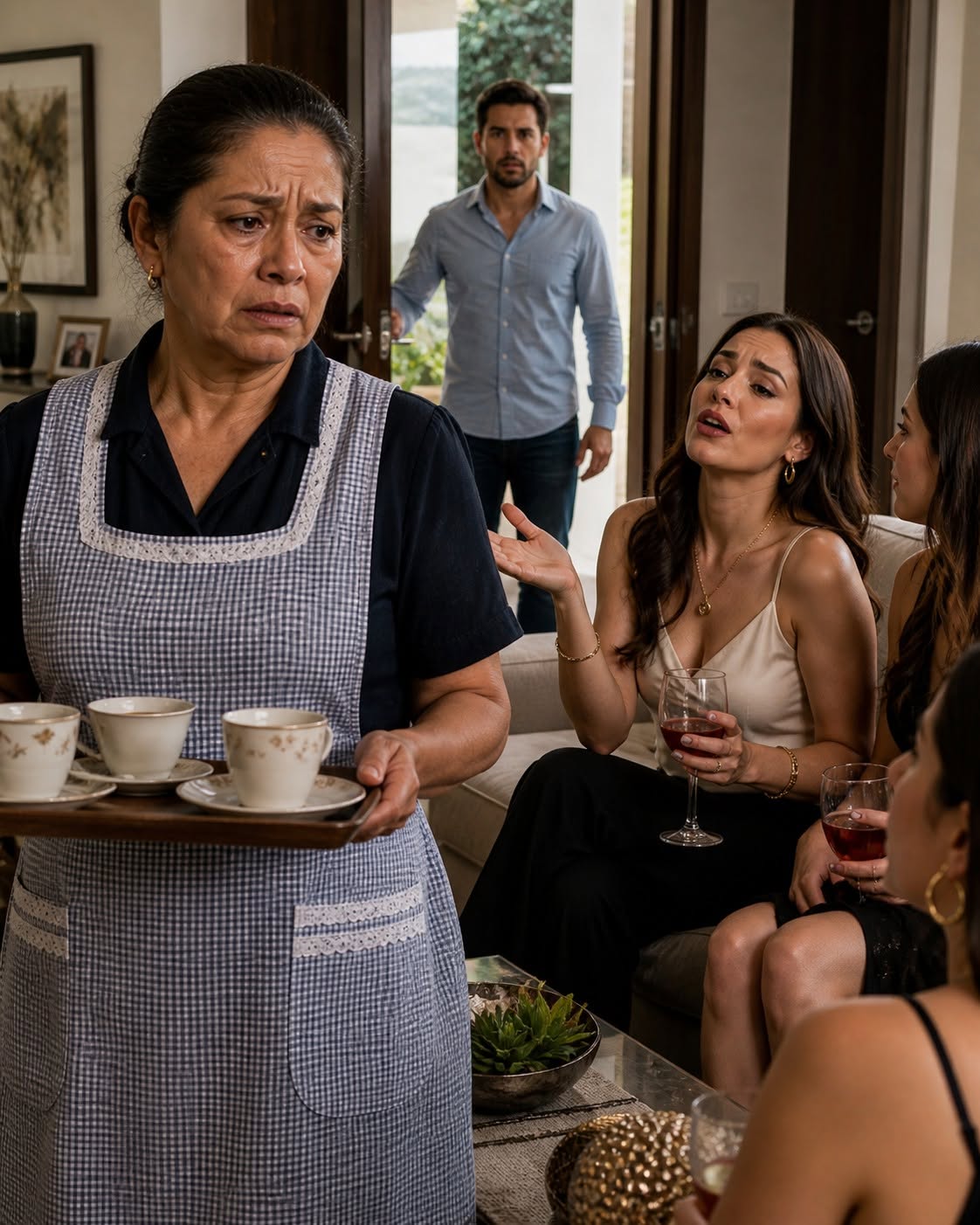
All your life, decisions were made around you. Men left, bosses ordered, rich women inspected, landlords threatened, and you adjusted. Even in this house, you had moved like a guest trying not to disturb the people who hurt you.
Now your son is handing you the center of the room.
You look at Mariana.
She looks back with pure hatred.
You say, “I want you out.”
The words are not loud.
They do not need to be.
Mariana steps toward you. “You ungrateful old woman.”
Andrés moves between you so fast the chair behind him tips. “Enough.”
Mariana’s face twists. “This is what you wanted, isn’t it? To have your son all to yourself? Poor Chayo, the suffering mother. The saint with dirty hands.”
Your hands.
You look down at them.
They are older than Mariana’s. Brown from sun, marked by burns, cuticles rough no matter how much cream you use. Hands that folded tamales before dawn. Hands that washed other women’s silk blouses. Hands that held your son through fevers when no one else came.
Dirty hands.
You lift them slowly.
“These hands fed the man you married,” you say.
Mariana’s eyes flicker.
“And today, they are opening the door for you to leave.”
For the first time, she has no answer.
That night, Mariana does not pack.
Of course she does not.
She locks herself in the bedroom and calls her mother, her father, maybe half of Zapopan. You hear crying, shouting, threats, and the repeated phrase, “They are throwing me out over a misunderstanding.”
A misunderstanding.
You sit in the kitchen while Andrés makes tea with hands that still shake. He looks bigger than the boy you raised, but smaller than the man he pretends to be. Pain has a way of making adults look like children again.
“I’m sorry,” he says.
You shake your head. “You heard her. That was enough.”
“No,” he says. “I should have seen it before.”
You want to comfort him automatically. Mothers do that. We take the knife out of ourselves and use the handle to soothe the person who put it there.
But tonight, you are too tired to lie.
“Yes,” you say. “You should have.”
His eyes fill.
You keep your hands wrapped around the mug. “She was not always careful.”
He looks down. “I know.”
“You knew?”
His silence answers.
The truth is softer than Mariana’s cruelty but deeper. Andrés did not know everything, but he knew enough. He knew Mariana did not like you in the living room. He knew she called your food heavy. He knew she corrected your pronunciation in front of guests and then said you were too sensitive.
He knew.
He just loved peace more than he loved justice.
“I thought it would get better,” he says.
You nod. “People say that when they are not the ones being made smaller.”
He covers his face.
You do not hug him yet.
Not because you do not love him, but because love without truth becomes another room where women disappear.
The next morning, Mariana’s parents arrive.
You are sweeping the courtyard when the black SUV pulls up. Her mother steps out first, wearing sunglasses large enough to hide contempt. Her father follows with the exhausted confidence of a man used to solving problems with checks and insults.
Mariana rushes out in designer slippers, crying like she has been held captive.
Her mother embraces her dramatically. “Mi niña.”
You hold the broom and watch.
Her father turns to Andrés. “We need to speak like adults.”
Andrés stands beside you. “Then start by apologizing to my mother.”
The man looks at you as if you are a chair he has been asked to greet.
“With all due respect,” he says, which means none is coming, “this situation has gotten emotional.”
You smile a little.
Rich people love calling theft emotional when they are caught before court.
Mariana’s mother looks at you. “Doña Rosario, you must understand. My daughter has certain expectations. She was not raised to live with servants.”
Andrés goes rigid.
You lift one hand slightly. “Let her finish.”
The woman does. That is the beautiful mistake of arrogant people. They believe every room has been built to receive their opinions.
“She should have her own home, her own staff, her own environment,” Mariana’s mother continues. “If Andrés wanted to keep supporting you, he should have arranged that separately.”
You nod slowly. “Like in an apartment far away?”
“Exactly.”
“And who would pay for that?”
She blinks. “Well, Andrés, of course.”
You glance at your son. “And if this is my house?”
Her expression flickers. Mariana must not have told them that part yet.
Andrés opens the folder again. He has not let it leave his side. “The property is in my mother’s name.”
Mariana’s father frowns. “That cannot be right.”
“It is.”
Mariana’s mother removes her sunglasses. “Mariana?”
Mariana looks away.
The courtyard fills with a silence more honest than any confession.
Her father turns back to Andrés. “Then transfer it. You bought it,
ADVERTISEMENT
