ADVERTISEMENT
What WD-40 Really Stands For
Most people keep a can of WD-40 within arm’s reach and rarely think twice about it. It sits on garage shelves, under kitchen sinks, and in toolboxes—always ready to silence a squeak or loosen something stubborn. The blue-and-yellow can is so familiar that its label almost fades into the background. Yet despite how widely it’s used, the meaning behind the name WD-40 remains a mystery to many.
The question usually arises during a small, everyday battle. A rusted bolt refuses to turn. A garden hose nozzle won’t budge. You spray, wait a moment, and suddenly the problem disappears. And then it hits you: What does WD-40 actually stand for?
Once you ask, the answer leads to a surprisingly fascinating origin story—one rooted not in garages or workshops, but in Cold War science.
Born from a Military Problem
WD-40 didn’t start as a household staple. Its story begins in 1953, during a time when engineering and national defense were closely intertwined. A small team at the Rocket Chemical Company was tasked with solving a very specific and high-stakes problem: preventing corrosion on missile components.
Moisture was the enemy. Even small amounts of water could compromise sensitive metal parts, and failure wasn’t an option.
The project was led by chemist Norm Larsen, whose goal was not to invent a multi-purpose spray, but to create a formula capable of completely displacing water while leaving behind a protective coating on metal surfaces. The team worked methodically, testing formula after formula.
The first attempt didn’t work.
Neither did the second.
Or the third.
In fact, thirty-nine attempts failed to meet the strict requirements of aerospace and defense engineering.
Then came the breakthrough.
The Meaning Behind the Name
The fortieth attempt succeeded.
And that success is permanently embedded in the product’s name.
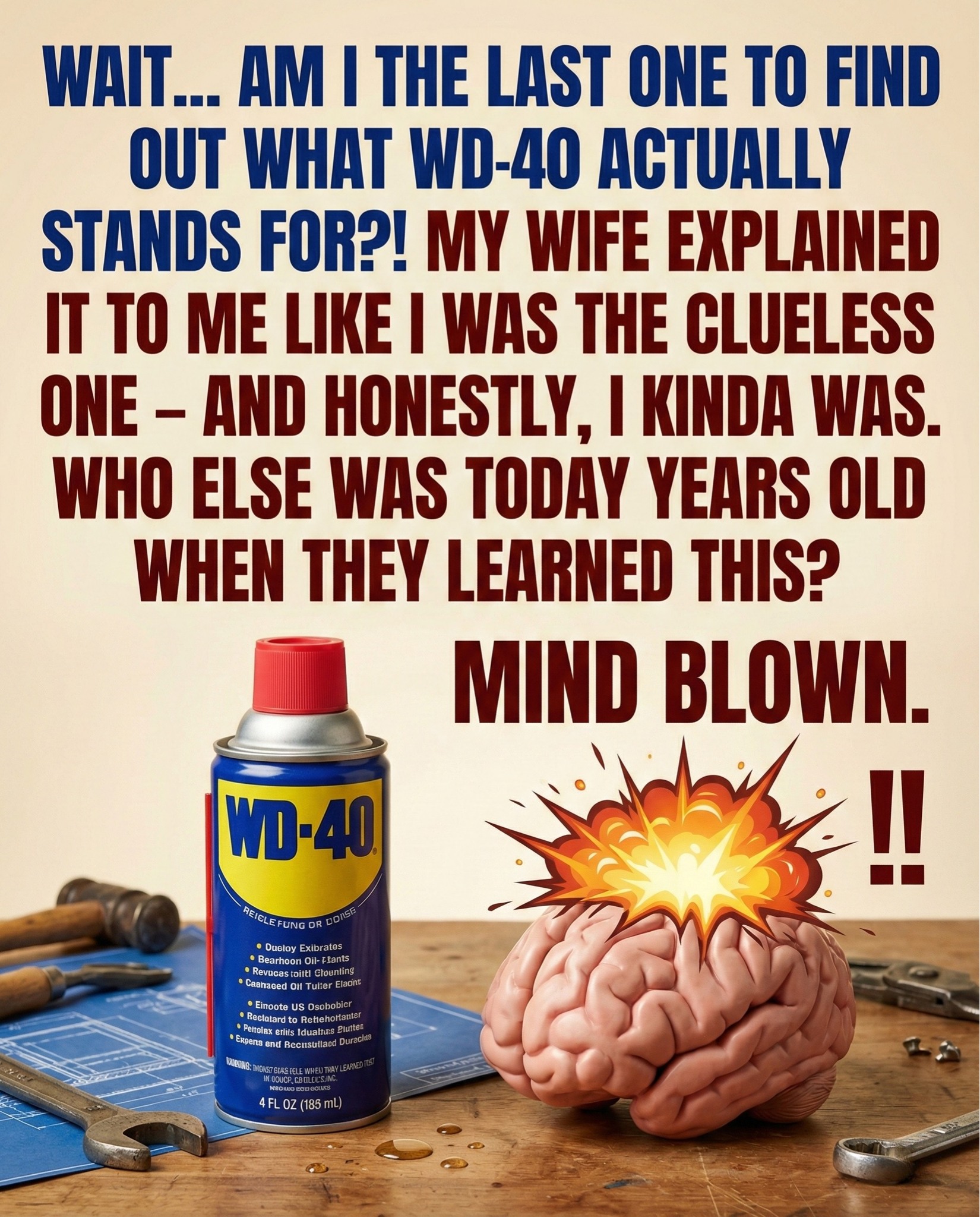
- WD stands for Water Displacement
- 40 refers to the 40th formula
There was no branding trick or clever marketing spin—just a straightforward description of how the product came to be. Few consumer products are so literal in their naming, and even fewer wear their trial-and-error history so openly.
From Missile Protection to Household Essential
What transformed WD-40 from a military solution into a global household staple was simple discovery. Once the Rocket Chemical Company realized how effective the formula was, production expanded beyond defense applications.
Employees took it home. Friends borrowed it. Word spread quickly.
People discovered it could:
- Loosen rusted bolts and tools
- Silence squeaky hinges
- Protect metal from moisture
- Cut through grime and residue
- Free stuck locks, zippers, and mechanisms
Before long, WD-40 became shorthand for “the thing that fixes it.”
Mechanics used it on engines. Cyclists reached for it for chains. Homeowners sprayed it on doors, grills, garden tools, and lawn equipment. Its versatility built a reputation rooted not in hype, but reliability.
Eventually, the Rocket Chemical Company renamed itself the WD-40 Company, acknowledging what had become obvious: this single formula had outgrown its original mission.
A Product Built on Persistence
see continuation on next page
ADVERTISEMENT
