ADVERTISEMENT
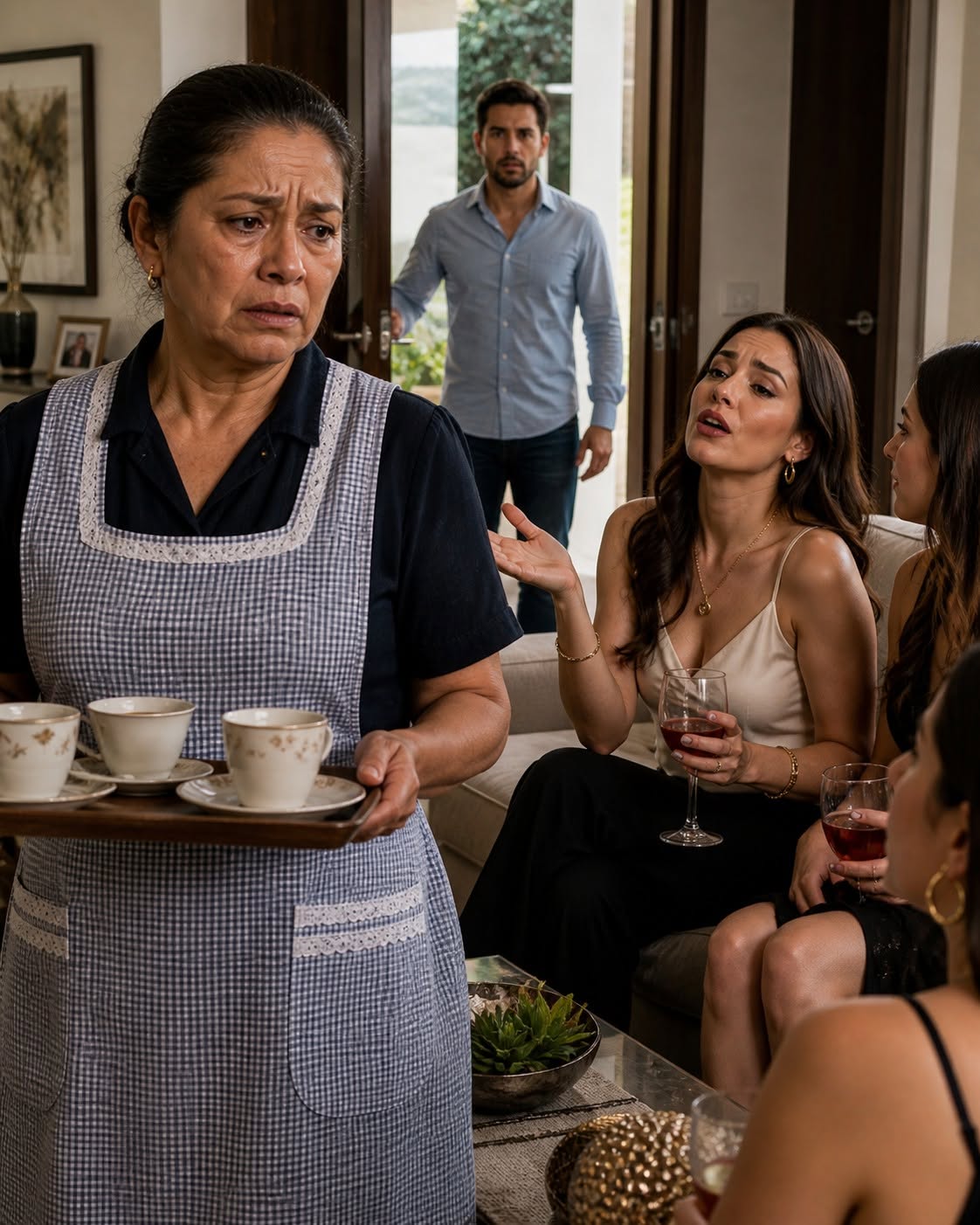
You stand in the dining room with the coffee tray trembling in your hands, the smell of cinnamon rising like a memory you suddenly wish you could hide. Mariana’s friends stare at you the way rich women stare at something they do not want to touch. Their painted smiles freeze halfway between amusement and pity.
Behind you, the front door opens.
You do not turn around at first. You already know that sound. Andrés always pushes the door softly, like he still remembers coming home late from school and not wanting to wake you after your double shift.
But this time, the door does not close softly.
It slams.
Mariana’s smile disappears so fast it almost feels like justice.
You turn your head and see your son standing in the entryway, still wearing his work shirt, a folder gripped in one hand, his face drained of all warmth. Andrés looks at you first, then at the tray, then at Mariana and her friends sitting around a table filled with food you cooked.
Nobody speaks.
The silence has weight.
Mariana sets her glass down slowly. “Andrés, you’re home early.”
He does not answer her.
His eyes return to you. “Mamá, put the tray down.”
You try to smile, because mothers do foolish things when their children are hurt. You try to make the room smaller, softer, less dangerous. “Mijo, it’s just coffee.”
“No,” he says, his voice shaking. “Put it down.”
Something in his tone reaches the part of you that has been tired for years. You lower the tray onto the table. One cup rattles against its saucer, spilling dark coffee over the white cloth Mariana insisted was imported.
One of Mariana’s friends lifts her purse away from the stain.
That small movement almost breaks you.
Andrés steps into the dining room. “Say it again.”
Mariana blinks. “What?”
“What you just said about my mother.”
Her cheeks flush. “You misunderstood.”
“I heard every word.”
The room tightens.
Mariana gives a small laugh, too high, too sharp. “Ay, Andrés, don’t start. We were joking.”
You look at your son, and for a terrible second, you fear he might believe her. Not because he is weak, but because love makes people slow to accept cruelty when it wears a familiar face. You know that better than anyone.
But Andrés does not look confused.
He looks finished.
“You told them my mother lives here because I pity her.”
Mariana’s friends look down at their plates. One of them suddenly becomes fascinated by her bracelet. Another reaches for her phone, probably hoping the floor will open and swallow her before the scene becomes contagious.
Mariana crosses her arms. “Well, is that not true?”
The words hit the room like a second slap.
You breathe in.
Andrés goes still.
Mariana must see the danger, because she quickly adds, “I mean, I’m not saying it in a bad way. Your mom had nowhere else to go. We helped her. I just don’t like pretending this is some equal arrangement.”
You feel your fingers curl into your apron.
All your life, you have been poor, tired, ignored, underpaid, and underestimated. But never once had you felt as small as you feel standing in that house, listening to your daughter-in-law explain your place like you are an old chair Andrés rescued from the street.
Andrés lifts the folder in his hand.
“That’s interesting,” he says.
Mariana’s eyes flick to it. “What is that?”
“The truth you forgot to ask about.”
You do not understand, but Mariana seems to. Not fully, maybe, but enough. Her face changes again, and this time fear slips through the makeup.
Andrés walks to the head of the table. He does not sit. He places the folder down carefully, almost gently, and the sound makes everyone flinch.
“Before my wife continues humiliating my mother in front of guests,” he says, “let’s explain who lives here out of pity.”
Mariana stands. “Andrés, not in front of my friends.”
He looks at the women at the table. “They were comfortable hearing my mother be insulted. They can be comfortable hearing the correction.”
One friend whispers, “Maybe we should go.”
“No,” Andrés says. “Please stay. You were invited for coffee.”
His voice is polite, but there is nothing soft in it.
You step toward him. “Mijo, leave it. I don’t want problems.”
He turns to you, and in his eyes you see the little boy with patched shoes, the teenager studying under a flickering kitchen bulb, the young man who swore one day you would never have to scrub another stranger’s bathroom.
“You are not the problem, Mamá,” he says.
Mariana laughs bitterly. “Of course she isn’t. She never is. Everything is always about your poor mother and her sacrifices.”
Andrés opens the folder.
You look down and see documents. Bank papers. Property records. Copies of transfers. Your name appears on one page.
Rosario Méndez García.
Your heart stumbles.
“What is that?” you whisper.
Andrés does not answer immediately. He looks at Mariana. “Tell her.”
Mariana’s mouth tightens. “I don’t know what you’re talking about.”
“Yes, you do.”
“Andrés,” she warns.
He slides the first page across the table. “This house is not mine.”
The room goes silent again.
Mariana’s friends look up.
You stare at your son. “What?”
Andrés turns to you fully. His anger breaks for a moment, and something tender and guilty takes its place. “This house is yours, Mamá.”
You almost laugh because the words make no sense. Yours? This house with marble floors, tall windows, designer lamps, and a kitchen where Mariana once told you not to hang your old copper pot because it made the place look provincial?
Yours?
You shake your head. “No, mijo. Don’t say things like that.”
“It’s true,” he says. “I bought it in your name two years before I married Mariana.”
The room begins to tilt.
You grip the back of a chair.
Andrés speaks faster now, as if he is afraid you will stop him. “When I got my first major bonus from the firm, I used it as a down payment. I wanted you to have security. I wanted a home no one could take from you.”
Your eyes fill before you can stop them.
He looks ashamed. “I didn’t tell you because I wanted it to be a surprise when the mortgage was fully paid. I thought I was protecting you. But I should have told you the day Mariana moved in.”
Mariana slams her hand on the table. “That is not fair.”
Andrés turns toward her. “No. What’s not fair is you calling my mother a charity case while living in her house.”
One friend gasps softly.
Another whispers, “Oh my God.”
Mariana looks at them, panicked. “Don’t listen to him. This is marital property.”
Andrés shakes his head. “No. It isn’t.”
He pulls out another document. “You know how I know? Because today I came from the notary. I went there after the bank called me about a loan application.”
Mariana’s face empties.
You feel the room change.
Something worse is coming.
Andrés places the second page on the table. “A loan application using this house as collateral.”
You look from the paper to Mariana.
She does not deny it.
Her friends start shifting in their chairs. No one wants coffee anymore.
Andrés’s voice drops. “The application included my mother’s forged signature.”
The words hit you slowly.
Forged.
Signature.
House.
Your house.
You look at Mariana, and for the first time since she entered your life, you see her without perfume, silk, or polite poison. You see hunger.
She wanted more than to humiliate you.
She wanted to erase you legally.
Mariana points at Andrés. “I was trying to help us.”
“Us?” he repeats.
“Yes, us. Your business has been unstable. My father’s investment fell through. We needed liquidity.”
You hear the fancy word and almost smile. Liquidity. That is what women like Mariana call theft when they do it with clean nails.
Andrés pulls out another page. “Then why was the money supposed to go to an account in your mother’s name?”
Mariana freezes.
Her friends stare at her now, not you.
You see her calculate. She is looking for a version of the truth that still leaves her beautiful. But there is no flattering way to explain forging your mother-in-law’s signature to borrow against a house you mocked her for living in.
You finally speak.
“My signature?”
Your voice sounds small, but everyone hears it.
Andrés’s face softens. “Yes, Mamá.”
You step toward the table. He hands you the paper gently, like it might cut you. Your name is typed at the top. Below it is a signature that looks almost like yours, except too smooth, too practiced, too proud.
You never signed like that.
Your signatures have always been tired, rushed, a little uneven from years of hands swollen by work.
This one has never scrubbed a floor.
You look at Mariana. “You signed my name?”
She lifts her chin. “I didn’t submit it.”
Andrés lets out a short, bitter laugh. “Because the notary called me to verify.”
“Exactly,” she says quickly. “So nothing happened.”
Nothing happened.
You think of all the times something almost happened in your life and still left a scar. The almost eviction. The almost unpaid school fee. The almost sickness you ignored because medicine was too expensive. People with money think harm only counts when paperwork finishes.
You fold the page once.
Then again.
You place it on the table.
“You were going to steal my house,” you say.
Mariana’s face hardens. “Your house? Please. You didn’t buy anything. Andrés did.”
You feel the old shame rise, the familiar reflex to lower your eyes when someone with softer hands tells you what you deserve. But Andrés speaks before you can fall into it.
“She bought it before I ever had money,” he says.
Mariana turns. “What does that mean?”
He looks at you. “She bought it with every night she didn’t sleep. Every meal she skipped so I could eat. Every peso she saved for my books. Every time she walked to work so I could take the bus to school.”
The room blurs.
“Mijo,” you whisper.
“No,” he says, his voice breaking. “I should have said this years ago.”
He turns back to Mariana. “This house is in her name because there is no version of my success that does not belong to her first.”
That is when the first friend stands.
She is the one who asked who you were. Her face is pale now, her lipstick suddenly too red. “Mariana, I think I should leave.”
Mariana snaps, “Sit down.”
The friend stares at her. “Don’t talk to me like that.”
It is a small rebellion, but you feel it in the air.
Another friend gathers her purse. “You forged his mother’s signature?”
Mariana’s voice rises. “I said it didn’t go through.”
The friend shakes her head. “That’s not the comforting part you think it is.”
One by one, they stand. The party dissolves not with shouting, but with the sound of chairs sliding back and expensive sandals moving toward the door.
Mariana watches them leave, and for the first time all afternoon, she looks truly wounded.
Not because she hurt you.
Because they saw.
When the last friend exits, the house becomes painfully quiet.
The food remains on the table. The gorditas are cooling. The pan de elote sits untouched except for one bitten corner. Your coffee has stained the cloth in a dark blooming circle.
Mariana turns on Andrés the second the door closes.
“You humiliated me.”
You almost admire the speed of it.
Andrés stares at her. “You called my mother slow, provincial, and a charity case in front of your friends.”
“She was standing there like staff!”
“She was carrying coffee you asked her to make.”
“I asked her to help because she lives here for free.”
Andrés laughs, but there is grief in it. “Still saying it.”
Mariana’s eyes shine with angry tears. “Do you know what it’s like for me? Do you know how people talk? I married an architect, and I have to explain why his mother lives in our house like some old village woman.”
You flinch.
Andrés sees it.
His face closes. “Say one more word about her.”
Mariana points at you. “She ruined this marriage before it even started. She was always here. Always cooking. Always watching. Always making you feel guilty.”
You think of the nights you ate alone in the kitchen so they could have dinner as a couple. The mornings you cleaned before Mariana woke up so she would not complain. The afternoons you stayed in your room because she said the living room felt crowded.
Always here.
In your own house.
Andrés says, “My mother gave us space. You filled it with contempt.”
Mariana’s tears fall now, but they are hot and furious. “I wanted a life with standards.”
“You wanted a stage.”
“I wanted a husband who wasn’t still attached to his mother’s apron.”
You close your eyes.
There it is. The insult hiding under every fake smile. The accusation that a son’s gratitude is weakness, that a mother’s presence is shame, that love from poor soil must be cut away before it embarrasses the furniture.
Andrés speaks quietly. “Pack your things.”
Mariana’s mouth opens.
“What?”
“Pack your things.”
She laughs. “You can’t kick me out.”
“No. But the homeowner can.”
Both of them look at you.
ADVERTISEMENT
